Calavera
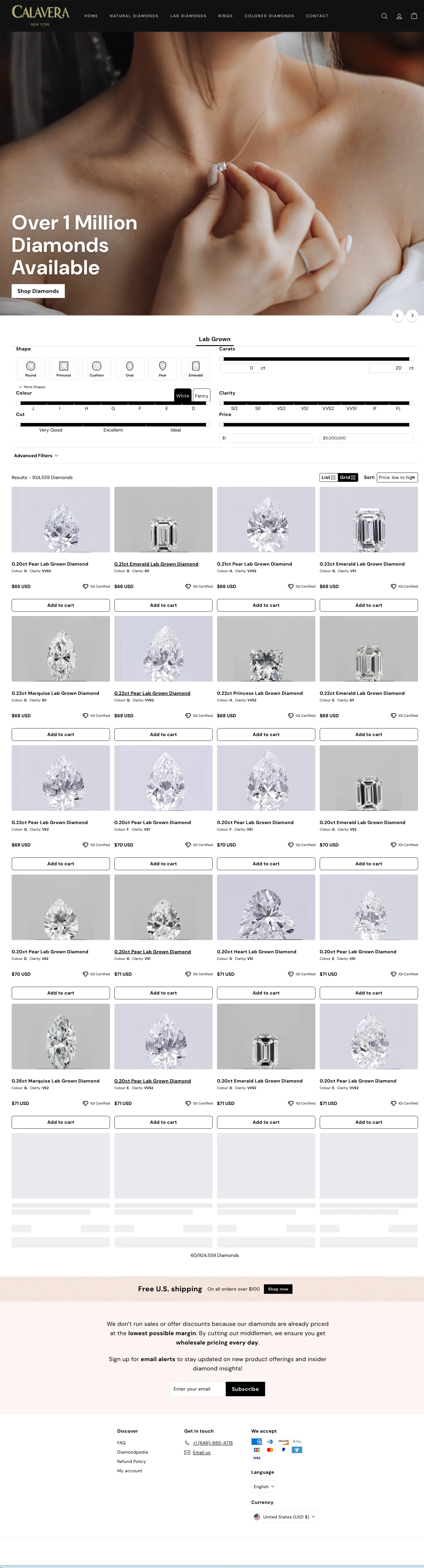
"Stock Nivoda template rebuilt as a luxury diamond marketplace with real-time inventory."
- 500K+
- +65%
- 100%
A diamond retailer stuck on a stock Nivoda template — slow, unchangeable, losing customers. Rebuilt as a headless platform: sub-50ms search across 500K+ stones, a ring builder, and a backend that runs itself.
End-to-end ownership — architecture, frontend, backend, infrastructure and deployment.
Problem
The stock Nivoda storefront gave no design control and lost customers before the catalogue loaded. There was no backend of their own, so custom search, pricing and checkout were all impossible.
Approach
- 01Built the storefront on Next.js: editorial design, 14 diamond shapes with interactive diagrams, endless scroll over Typesense search.
- 02Built a step-by-step ring builder — setting, diamond, metal, engraving, checkout — with state persisted in PostgreSQL.
- 03Replaced the dependency on Nivoda with eight services: an adaptive scanner across price bands, 200 parallel workers, and a map/price/rate pipeline.
- 04Added a versioned cache with ETag support — 95% hit rate, responses under 50ms — and a reservation layer that closes the double-sell window.
- 05Wired checkout to Shopify draft orders, with four sign-in methods, shareable cart and wishlist, promo codes and delivery estimates.
Live storefront · editorial



Outcome
- →From a standard Nivoda template to a fully custom premium platform.
- →500K+ diamonds searchable. Responses under 50ms across 28 filter parameters.
- →Zero double-sells since launch. Reservation system with atomic versioning and hourly refresh.
- →Ring builder live — complete step-by-step flow from setting to checkout, 40+ components.
- →43 frontend pages, 8 API endpoints, 32 test files (E2E + unit), 22 shared UI components.
- →15-page admin dashboard: 487K diamonds, 3 feeds, 99.7% pipeline success rate.
Business Impact
The ring builder opened purchase paths that did not exist before, and sub-50ms search deepened catalogue browsing. Double-sells are gone, and eight services keep inventory live without anyone touching it.
Redesign comparison

Under the hood
Customer Storefront
- Next.js 16 · React 19 · TypeScript
- Typesense · 28-facet diamond search
- Custom ring builder · 40+ components
- Radix UI · Embla Carousel · Motion
- Better Auth · 4 OAuth providers
Ingestion Pipeline
- 8 Azure microservices · Terraform IaC
- KEDA autoscaling · 0→200 workers
- Adaptive density scanning
- Pricing Engine · Rating Engine
- Atomic dataset versioning
Commerce & Data
- Shopify Headless · Storefront API
- Nivoda API · diamond holds
- PostgreSQL · Prisma 7
- Draft orders · promo codes
- Shareable cart + wishlist tokens
Infra & Monitoring
- Azure Container Apps · Docker
- Cloudflare CDN · Vercel
- Vercel Crons · hold refresh
- Playwright E2E · Vitest
- CI/CD: typecheck → deploy
Next.js stack — modern, stable, hire-able. Not a black-box theme.
I keep shipping features, fixes and integrations as the store grows. No agency lock-in.
The architecture scales with the catalog and traffic — no forced replatform.
Want a store that runs itself?
If you have a legacy store losing money to slow pages, manual order entry, or fragile integrations — let's talk. I take projects from architecture through launch and stay to keep them running.